
When reviewing magic the gathering (MTG) cards, it’s helpful to review all attributes on a card. Each playable card in-game tells a story. Magic has several type of cards (Instants, Sorceries, Artifacts, Creatures, Land, Enchantment and Planeswalkers) Below is an example of a black creature card.
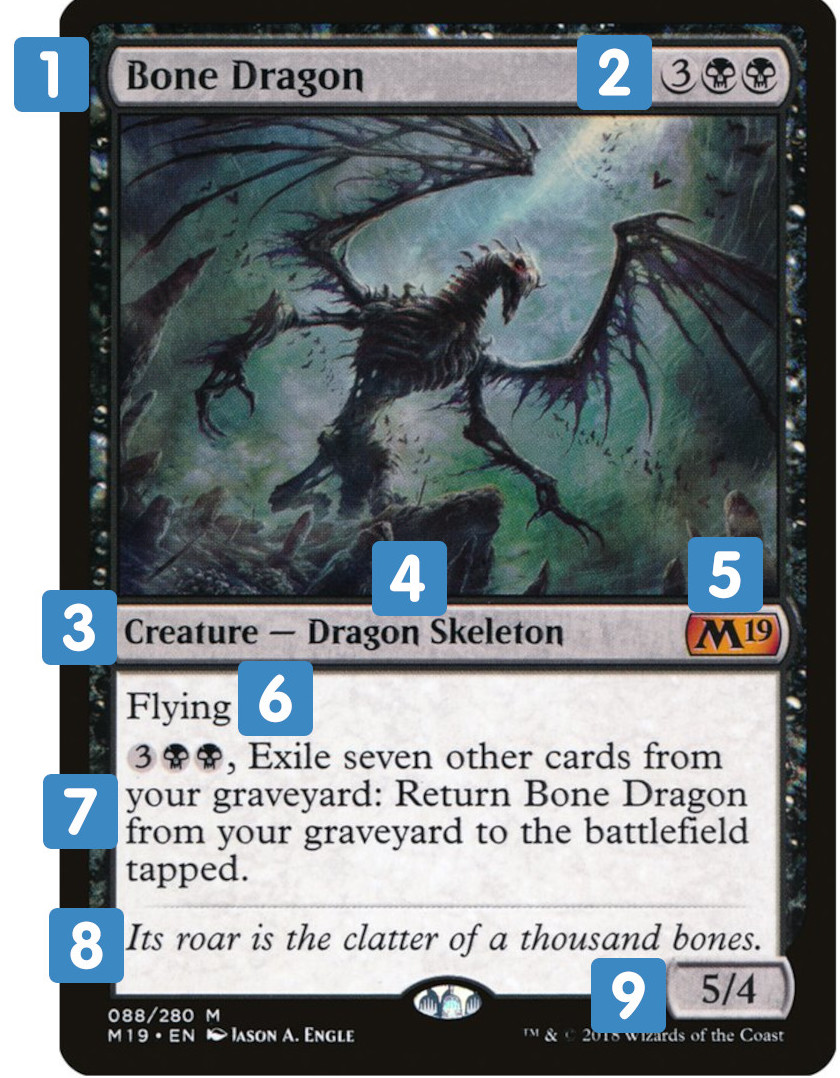
1) Name: Every card has a name. Usually a card’s name is not relevant beyond the main identifier for a card, but occasionally a card ability will require you to name a card.
2) Mana Cost: This tells you how much mana you need to cast a card, and what color it must be. Here the number three refers to three generic mana of any color, and the two skull symbols next to it refer to two black mana. This card has a total ‘converted mana (now referred as mana value) cost’ of five, and to cast it, at least two of that mana needs to be black typically produced by ‘swamp lands’. This card is considered to be a ‘mono-black’ card.
3) Card type: This tells you what type of Magic card spell you have in-hand. The main categories are Land, Creature, Sorcery, Instant, Enchantment, Artifact, and Planeswalker (and Battle, but that’s brand new). What category a card falls into has all sorts of ramifications for how the card works and when you can play it. For instance, most cards need to be played in your turn at one of two main phases. Cards which are instants or creatures with flash, can be used at any time. Sorceries and instants go to the graveyard after a one-time effect, but other card types stick around on the battlefield and are considered permanents. Lands don’t have a casting cost, but you can usually only play one per turn.
4) Card subtype: Some cards, usually Creatures, have a subtype as well as type. Here, the card has two subtypes: dragon and skeleton. If a card tells you it has a particular effect on all dragons, or all auras, or triggers when a dragon, skeleton, or goblin is played, now you know where to look.
5) Set symbol: This part of the card indicates originating set and card rarity (mythic rare, rare, uncommon, common). This card is a mythic rare card from the Core Set 2019. It’s worth about $0.55.
6) Rules text. This indicates everything a needs to know how a card works. On creature cards, like this one, you’ll first find any ability keywords that work as a shorthand for how the card functions. This can fly and flying creatures like this one can only be blocked by other flying creatures, or cards with reach. Interestingly, other card types like Sorceries and Instants will usually have any keywords at the end of the rules text.
7) More rules text: Besides flying, This area also indicates what other card abilities are available. For 5 more mana, AND Exiling 7 cards from your graveyard, you can return this creature from the graveyard to the battlefield.
8) Flavor text: This is just for fun – it has no rules implications but it’s great for lovers of story and lore. Flavor text ranges in quality and tone from evocative lore to corny puns.
9) Stat line: Only Creatures have this section. It tells players the Power (5) and Toughness (4) of a Creature. Power dictates how much damage the Creature can place upon other creatures in combat, while Toughness is how much damage it can take before it’s destroyed. Note that damage goes away once your turn ends.
Planeswalker Cards
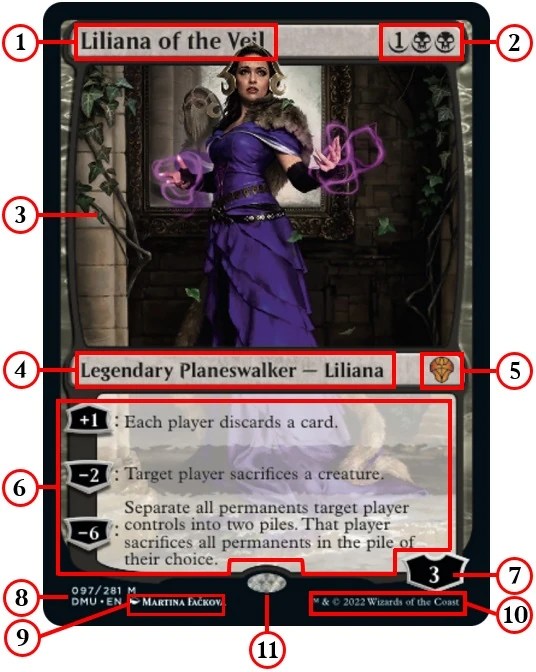
1) Name: The card’s name, what it is called. Usually a card’s name is not relevant beyond being the main identifier for a card, but occasionally a card ability will require you to name a card.
2) Mana Cost: This tells you how much mana you need to cast a card, and what color it must be. Here the number three refers to three generic mana of any color, and the two skull symbols next to it refer to two black mana.So this card has a total ‘converted mana cost’ of five, and to cast it, at least two of that mana needs to be black.
3) Card Art: This is typically a humanoid image of the planes-walker. It’s interesting to me as a visual style that the head of the planes walker over laps the top area on the card.
4) Card type: This tells you what type of MTG card you’re dealing with. The main categories are Land, Creature, Sorcery, Instant, Enchantment, Artifact, and Planeswalker (and Battle, but that’s brand new).What category a card falls into has all sorts of ramifications for how the card works and when you can play it. For instance, the term legendary, means you can only have one copy of this card out on the battlefield at a time.
5) Set symbol: This part of the card tells you its MTG card rarity (shown by the color) and what MTG set it is from (shown by the symbol)
6) Loyalty Counter Cost: For this card, this layout has 3 options. You can add a token, remove 2 tokens and remove 6 tokens. You must have the number of loyalty counters to select your option. This planeswalker enters with 3 tokens see #7 below.
7) Loyalty Counters: Planeswalkers run on loyalty counters. This number represents the amount of loyalty this planeswalker has after it has entered the battlefield. This number is also its toughness – loyalty counters at zero will cause the card to be removed from the battlefield.
8) Set details: This box will tell us the set number 97, set code (DMU: Dominaria United) and the artist whom created the art.
9) Artist Credit: The artist who created the image on the card will be placed on the lower left area of the card. For this card, it’s Martina Fačková – be sure to check out more of this artist’s work at https://martinafackovaart.com. Without artists, our Magic cards would be really boring. Every year at GenCon, artists have booths at GenCon. There is an entire Area devoted to the people who create art for Magic and other games. You can meet artists in-person, see and discuss their ideation behind their art. More info about GenCon can be found at the GenCon Official Website.
10) Wizards of the coast copyright: This is helpful to determine the year the card was printed.
11) Holofoil Graphic: Not all cards have a holofoil graphic. Cards which have a higher rarity level will have a holofoil graphic to prevent copying and piracy.
INTERESTED IN MORE CARD TYPE CONTENT? This page gets a good amount of hits. I was thinking about adding more to the page content to cover more card types. Send a message and let me know if you want more card type examples.
WANT TO LEARN TO PLAY MAGIC? If you’re new to magic and want to learn more, there is Magic for Beginners Facebook Group – Great questions are asked for new players entering the game.
 JVS
JVS 