OVERALL: This card is about how I carry myself. I am quiet more than most people but I extremely well at listening/ observing skills – I typically pick-up details that are often missed by others. I am also strategic in my actions especially with design work. I like the long-game. Seeing and discovering patterns which add up through time to something bigger is important.
GAME ATTRIBUTES: Black/Green Deathtouch creatures are the worst adding forced in-game fighting is a extra layer of board state removal making for very successful single play creature spell.
A link on my website will assist users in comprehending the anatomy of Magic: The Gathering cards. Understanding details will deepen understanding of the cards’ intricacies I’ve created.
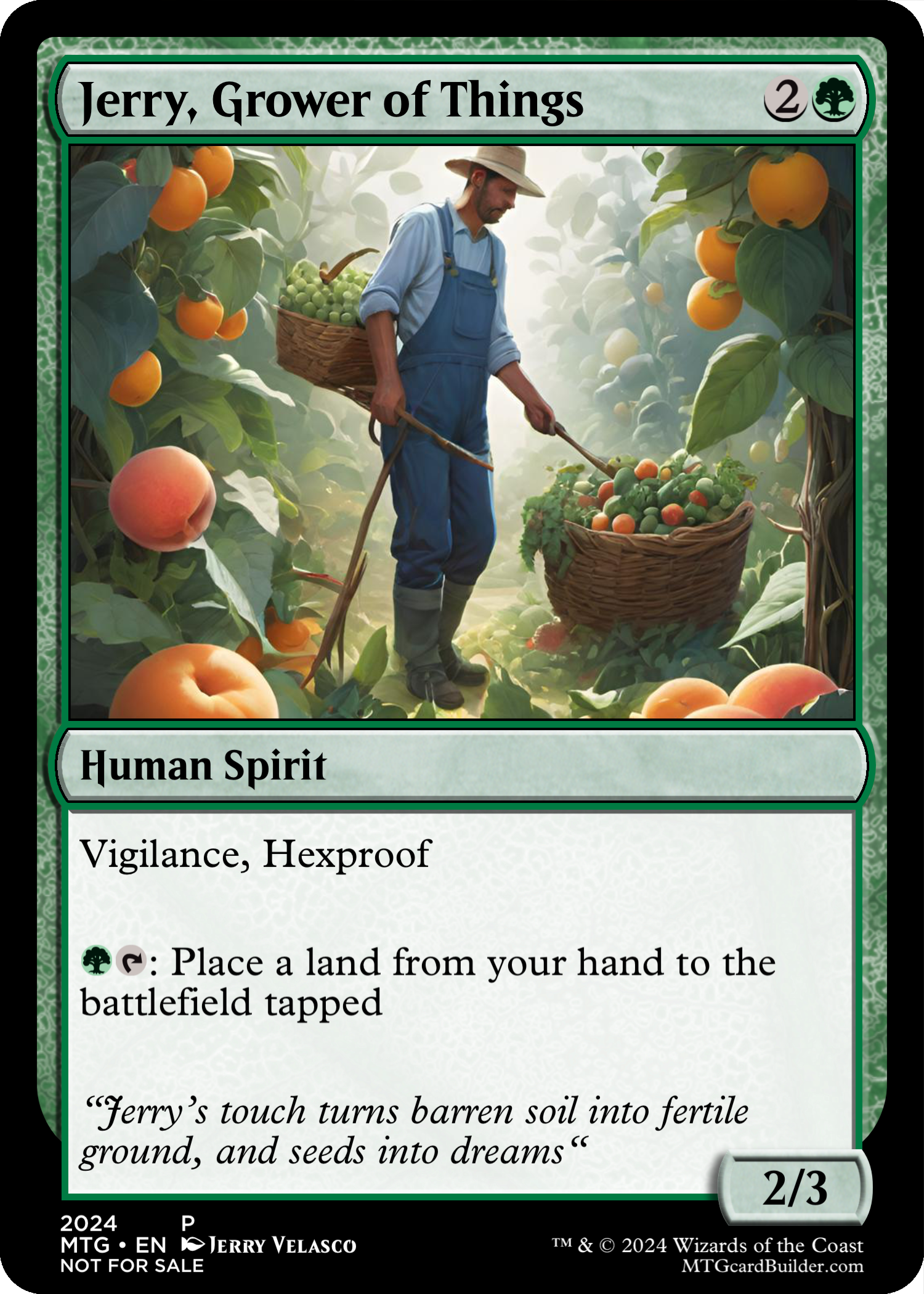
“OVERALL: This card reflects my perspective on the world around me. I’m not one to destroy; rather, I thrive on creating connections, meeting fascinating individuals, being inspired by other artists medium, nurturing ideas, observing group discussions unfold, and occasionally tending to my garden. I hold onto hope that the efforts I put into growing something will yield fruitful outcomes for all involved.
GAME ATTRIBUTES: This card’s core function is to allow the player to place an extra land per turn. This will allow the player to grow their resources faster than the other players and eventually allow them to cast more spells over the course of the game.
A link on my website will assist users in comprehending the anatomy of Magic: The Gathering cards. Understanding details will deepen understanding of the cards’ intricacies I’ve created.
In any art show where works are displayed, it’s essential to provide background information about the piece you’re viewing. A statement adds depth to the viewer’s understanding, enabling them to suspend or support their judgment more effectively.
Before you form judgments based on the media frenzy surrounding AI and AI generative imagery (AIGI) creation, I urge you to hear me out. I’ve thoroughly considered the subject and its role in my work and have taken great care to explain it below. I meant for this post to be a short post, but its gotten longer and I can’t seem to disconnect all the logic and writing without removing deep meaning to it all.
BEFORE MY PIECE: I had judged AIGI as negative and damaging to the arts and looked away and ignored AIGI. I also believed algorithms could NOT create imagery that competes with human artwork.
RESEARCH & INPUTS: It was clear I was going to need to explore the current status of AIGI. Besides reading a large amount of articles, I joined two opposing Facebook groups on AIGI to see what people in communities are saying.
1) One group was pro-AIGI and its channel is devoted to people who talk less and produce more. A lot of the posts are amazing and beautiful images, “AI Revolution – MidJourney AI, DALL-E 2, Stable Diffusion” – This group has 234k members. There is not any writing as much as showing images created by AIGI.
2) The other group, “Artists Against Generative AI ” which frequently post anti-AIGI content – This group has 98.4k members. I have learned a lot from both groups. One pushes hard and demonstrates work produced by AI and the other group tears down the AI and post real-world damage to artists and art.
HOW DOES AIGI WORK? I didn’t conduct deep research in this area but I’m sure its the image sampling inputs at the heart of controversy. (See image below)
RESEARCHING SOFTWARE: I was going to need to play with AIGI and see what it was all about. How are others making imagery? What software or online platforms do I use? Is it free or does it cost money? How much does it cost. I’m not going to pay for something I don’t understand or can see what it can do. I can’t do explore without a project or parameters and I didn’t want to read about it and regurgitate what I read from other people. This subject will most likely be its own post eventually.
PLANNING: To give my project a personal stake, I had to make it close to home and fun. Being a huge Magic the Gathering nerd, I decided to set the magic card as the format. Each card has art and text – it’s going to perfect. I also have a secret dream to be a magic card creator. (I took a test to become an intern for Wizards of the Coast and didn’t make it in. Out of 2000 test applicants, 2 people had perfect scores – Good bye dream!) To make it personal, I needed a reason for each card. I had some thinking to consider – Should I make one large format card? or should I make several actual cards? After some experimentation and testing, I decided to make cards based on my attributes in life. That went far, but it wasn’t enough since our lives are shaped by other people in our lives. – I began to widen the scope by adding other people as card stories. How many cards make a great story?
MY ROLE: Since I’m not producing the images or the text but I am directing someone/something else to produce work, My role was similar to an Art Director more than a singular artist. I was instructing others what and how to write / illustrate based on my project parameters.
CARD TEXT & STRUCTURE: Each card would be considered a ‘story block’. I first made a listing of 30+ card ideas knowing many of them will not make into the piece. I started with the basics, Title, Color type, Card attributes, flavor text and imagery description. (see Magic Card attributes) I chose the title and asked ChatGPT to write the flavor text. Sometimes the writing didn’t support the title and I re-wrote the title to focus the output text. I learned a lot about ChatGPT. I was really surprised that ChatGPT even knew what flavor-text on a magic card was. I asked for writing several times, once I was satisfied with the text, I moved on to image creation. Below is the text for card #4 or “Jerry, the Grower of Things.”
IMAGE CREATION & TRASH: After researching all the free AIGI applications, I found one that would produce imagery that looked professional, not photographic and somewhat illustrative in nature. This is where I learned about prompting the AIGI software. Prompting is similar to coding but regular English words – I am still not a master but I could get images to be produced to my liking. After producing 50-100 images, I would rank every image based on detail, imagery and composition. Every final image in each card took the making of 60+ images unusable for various odd reasons. Some images didn’t complete due to rules of imagery.
SURPRISE & FASCINATION: While on each prompting expedition, my goal was to be looking for the closest output of my prompts. I was also having fun in some regards to how the software would interpret some of my prompts and show me images that were actually better directions than the one I was pushing for. One day I will share the trash but that is another post or another piece to produce?
GRAPHIC PRODUCTION: Now that I had all the building blocks, I still had to assemble the card (See Attributes) and some details that I didn’t plan for that make a magic card a real magic card. Each card needed to look like a legitimate and playable magic card.
FINAL CARD WORK: Below is the final version of ‘Jerry, Grower of Things’ 4 of 28 cards. Now you have seen 1/28th of the final piece.
LAST THOUGHTS: Not sure how my piece would be accepted by other ‘artists’ at the one piece show. My assumptions were: 1) I expected was other artists at the show to hate my work since it was using AIGI. 2) I also thought some people might feel left out from my story. I only had 28 cards, I definitely have more than 28 people to include in the piece. In the end, I was exploring within a timeline and was probably sloppy and insensitive to leave out people are in my life and should be in the piece. What could go wrong? One person did speak up – my wife. I hurt my wife badly for not having her as a card in my show. It hurt me that she would take to heart and be hurt so deep. I love my wife so much – she is the grounding element of love in my life – It was not my intent to hurt anyone, especially her. I hope to find a way to fix this in both our hearts.
The opening night was well attended by friends and family to see some of the best Indianapolis local work. I was greeted by ‘the’ Dean Johnson (Scott Johnson and Bruce Dean) I conversed with many friends not seen since last years one piece show. Ultimately, the night went well. Thanks goes out to Centerpoint Brewery who donated beverages for the night.
The show was originally scheduled for end of May but due to another showing cancelling, this show will run an additional month, June 30th.
Where is my piece? It’s noted by the red arrow in the above photo. If you come into the CCIC Schwitzer Gallery turn right and follow the wall. I typically don’t reveal my work until the first week running of the show. I will start dropping hints and clues.
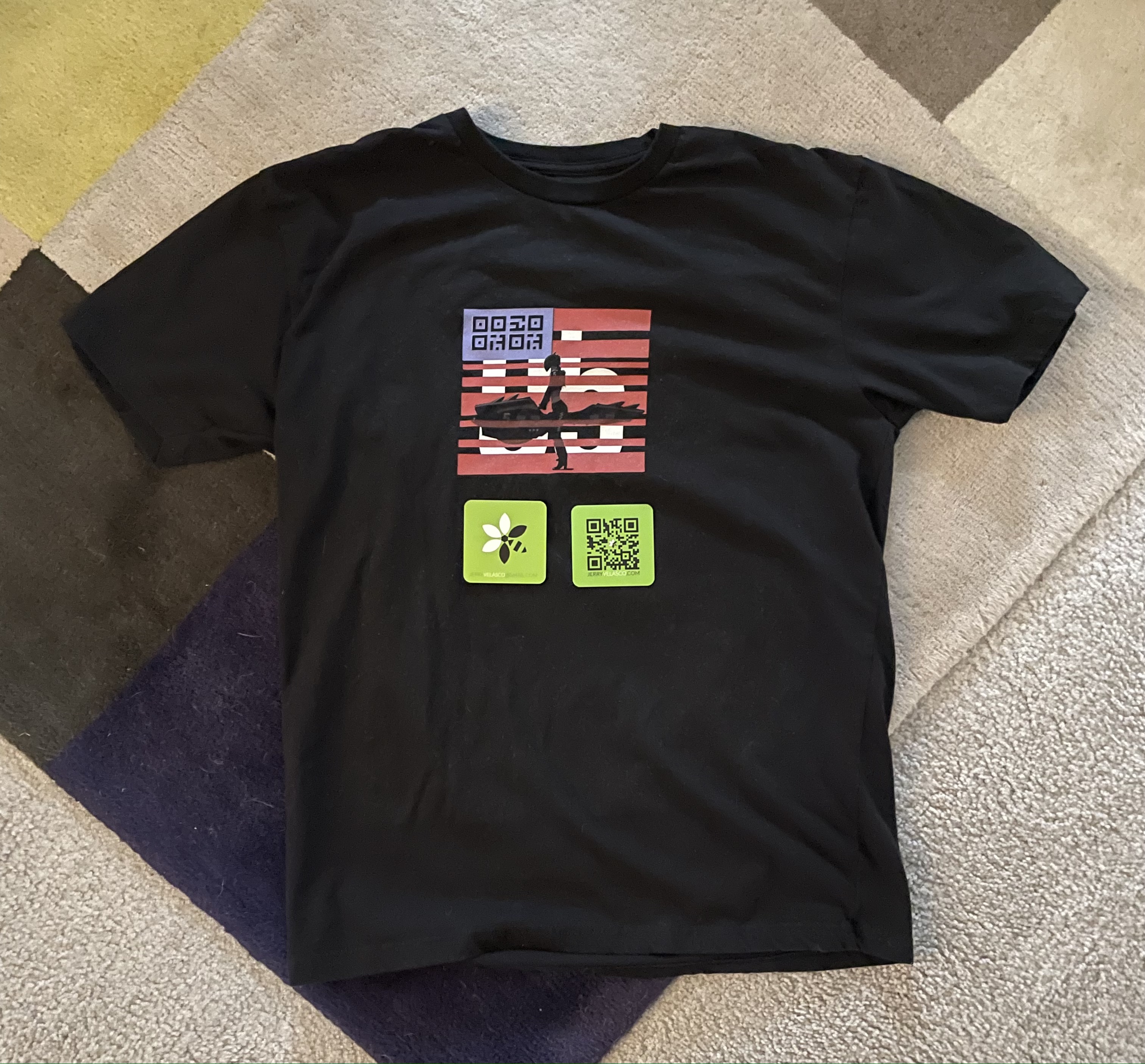
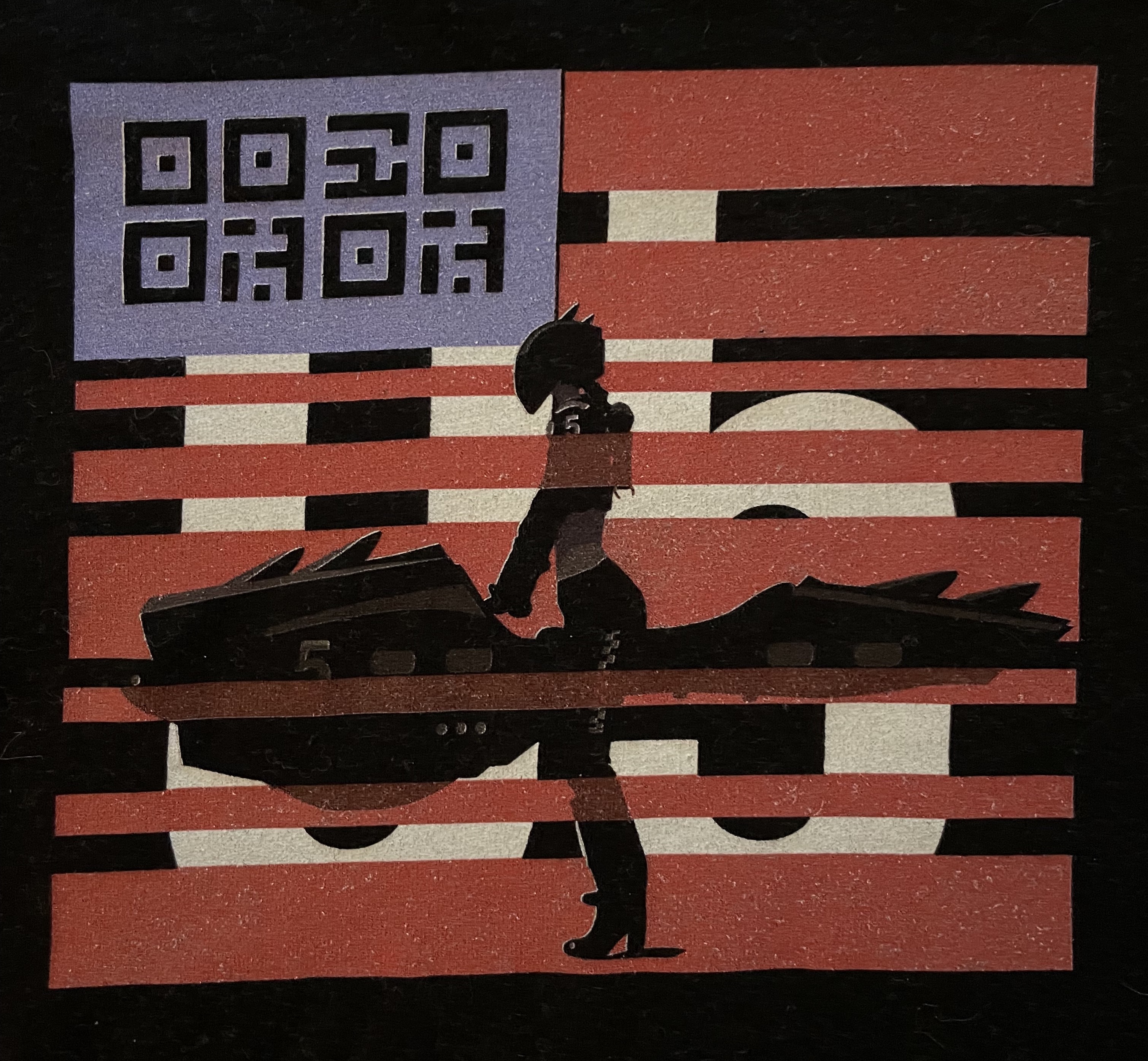
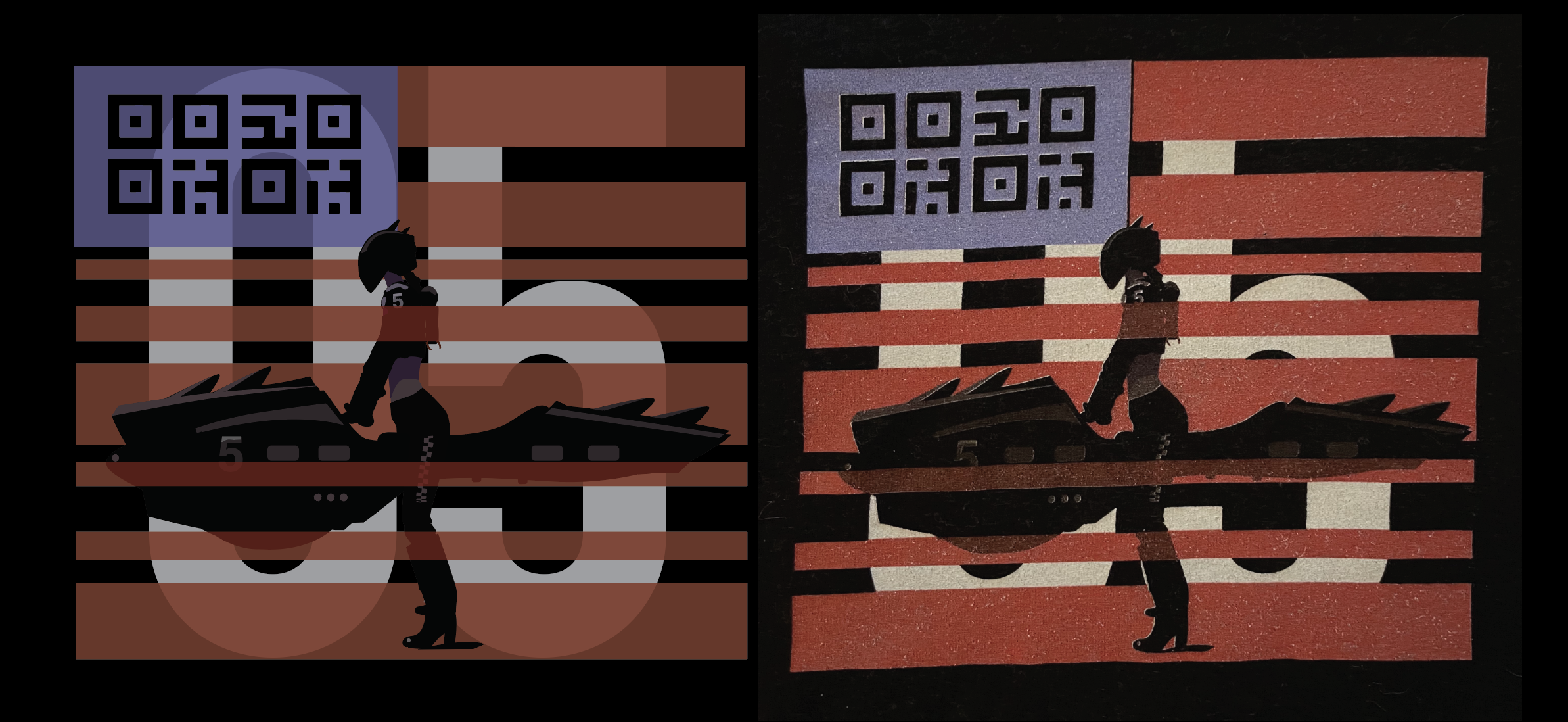
This is the final shirt design. It isn’t a sneak peak, as it’s the actual illustration on a shirt that I was going to wear on opening night. This shirt design was interesting since the transparency layering colors didn’t get translated very well. I don’t blame StickerMule. In hindsight, I should have broken the color blocks with actual colors instead of transparencies. I may try another shirt to see if I can fix the transparency colors. This will be the second to last post. The last post is going to give a glimpse into the greater concept of Roost-Haven.
(above: Shirt output from StickerMule)
(Above: Side by side comparison of design and shirt output)
SPOILER ALERT: I’m happy to announce that I began the digital pledge badges today. This is a digital badge only found in $20-$40 pledge. Below are the iterations. A & D are for single-person with difference on their names style. C is the family level pledge and could be single-use or be added to a family-badge (in addition, several individuals in the family could have single-person names). B is reserved for a organizational level or a family/person that has given beyond their category of pledge-type. Also to note, I originally wanted to bring about a sense of difference from the main BR UNITE graphic – so I added a star. As I designed more, I realized the star could represent an amount of pledges (As of this writing, I’m not sure the $1 pledges counts, but it could – Jury is out) More information can found about BR-UNITE stickers or my kickstarter. I thought I was thinking too much but there is currently a family-level pledge. Thanks in advance! Keep up the support by sharing the BR-UNITE duck art. Send feedback if you have time today.
As I talk to clients & recruiters about my depth of market space, I am sometimes told that “there aren’t enough wire-frame examples on your website.” For this reason, I’ve decided to attempt to show the footprint of missing content.
Am I missing current work examples? Yes. There are 7 total projects in the last 3 years that are not on my website. Most are missing due to confidentiality agreements and HIPPA. I truly respect my past clients so their data will never be shown on my website, emailed, placed in digital forms, etc. With that said, I can discuss my role in the projects as well as the challenges to my role in client environments.
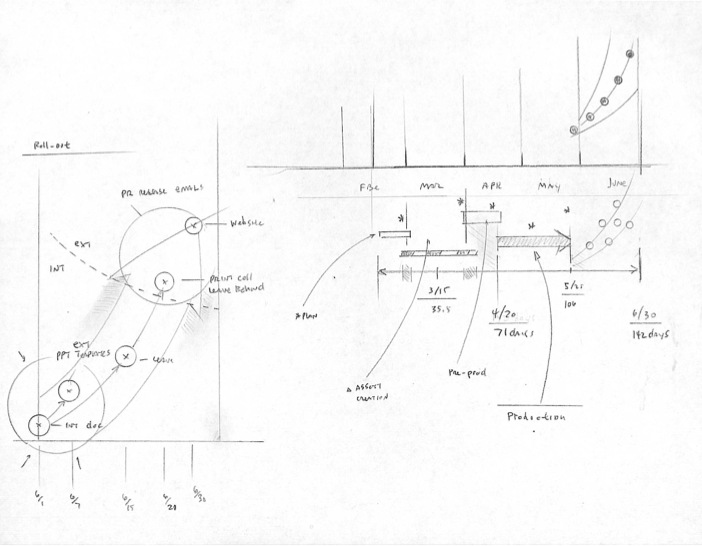
I was auditing my site today (Feb 21) and noticed there was a Sketch section with no sketches. Thats not me! I love grabbing a pencil or dry erase marker and going to town. I’m adding a small blog snippet to re-direct people to the newly updated sketch page. You can see one sketch below. I’ve also added 2 User Journey Maps. They are under work-product since they weren’t created a specific deliverables, but they were useful for conversation with business people and content writers. I’ve also added a journey map after the sketch below.
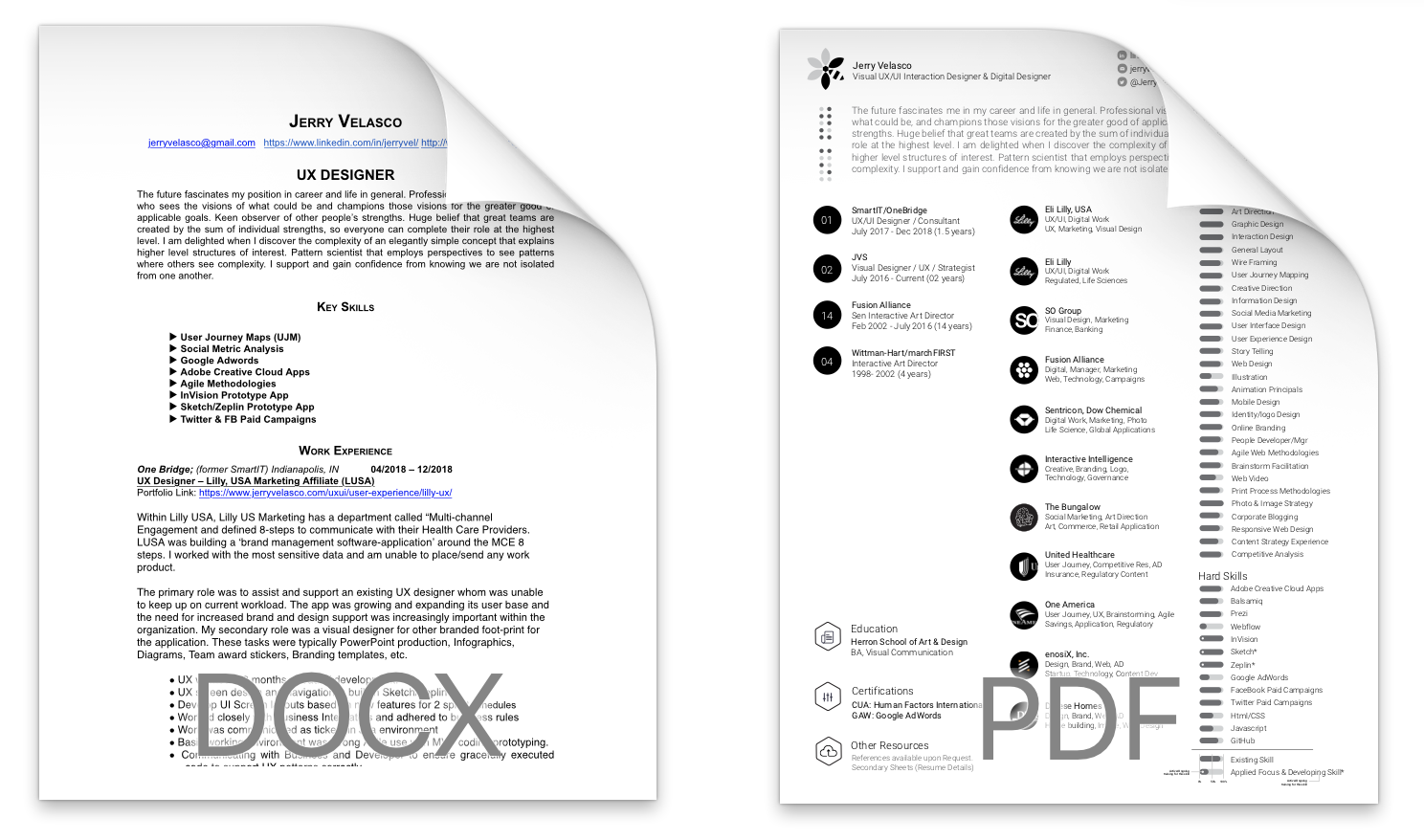
With good cause, I spend a good amount of time explaining and walking people through my resume. I asked myself, “How can I make better use of time with opportunity meetings?” I wrote a blog that walks through the content of my resumes. (yes there are two!) Let me know what you think!







 JVS
JVS 